Oldest Dinosaur Fossil discoveries continue to reshape what scientists know about the deep past, challenging long-held assumptions about when dinosaurs first appeared and where their story truly began. While textbooks often present dinosaur evolution as a clean timeline, the real picture is far messier—and far more fascinating.
For decades, paleontologists have searched for a single answer to a deceptively simple question: What is the oldest dinosaur fossil ever found? The truth is that there may not be one definitive answer. Instead, there are several contenders, each revealing a fragment of a much larger evolutionary puzzle.
Recent discoveries, combined with new analytical techniques and climate modeling, suggest that the earliest dinosaurs may have appeared earlier—and in more difficult-to-reach places—than once believed. Some of the oldest candidates are already known to science, while others may still be hidden beneath deserts, jungles, and ancient rock layers that humans can barely access.
Why Identifying the Oldest Dinosaur Fossil Is So Difficult
At first glance, it might seem easy to identify a dinosaur fossil: find dinosaur bones, date the rock layer, and compare the results. In reality, the process is far more complicated.
Dinosaurs did not suddenly appear overnight. They evolved gradually from dinosauriforms—reptile-like animals that shared some, but not all, dinosaur traits. This evolutionary overlap creates a gray zone in the fossil record, where scientists must decide whether a fossil represents a true dinosaur or a close relative that came just before them.
Many early fossils are also incomplete. In some cases, only a single bone or fragment is preserved, making classification difficult. Features once thought to be uniquely dinosaurian are now known to appear in multiple reptile groups, adding another layer of uncertainty.
Because of this, scientists often debate whether a fossil should be labeled as the oldest dinosaur or the closest known ancestor.
A Rainstorm in Brazil Changed Everything
One of the strongest candidates for the oldest confirmed dinosaur fossil comes from southern Brazil. In 2024, unusually heavy rainfall accelerated erosion near a reservoir in Rio Grande do Sul, exposing Triassic-era rock layers that had been hidden for millions of years.
Within these layers, paleontologists uncovered remarkably well-preserved remains of a large carnivorous dinosaur belonging to the Herrerasauridae family. This two-legged predator lived approximately 233 million years ago, placing it firmly among the earliest known dinosaurs.
What makes this discovery especially important is its completeness. Compared to other early finds, the Brazilian specimen includes more skeletal material, allowing scientists to confidently identify it as a true dinosaur rather than a dinosauriform.
This discovery reinforced the idea that South America played a critical role in early dinosaur evolution and that environmental factors—like erosion—can still reveal major scientific breakthroughs today.
Africa’s Oldest Confirmed Dinosaur Fossils
Not long before the Brazilian discovery gained attention, another important find emerged from southern Africa. In 2022, researchers announced the discovery of dinosaur remains in Zimbabwe dating back roughly 230 million years.
Among these fossils was a nearly complete skeleton of Mbiresaurus raathi, an early sauropodomorph dinosaur. This plant-eating lineage would later give rise to some of the largest animals ever to walk the Earth.
The Zimbabwe fossils represent the oldest definitive dinosaurs found in Africa, helping to confirm that early dinosaurs were already widespread across the southern supercontinent during the Late Triassic period.
Together, the Brazilian and African discoveries suggest that dinosaurs diversified and spread much earlier than once assumed.
The Controversial Case of Nyasasaurus
If the debate ended there, the answer would be straightforward. But one fossil continues to challenge the timeline.
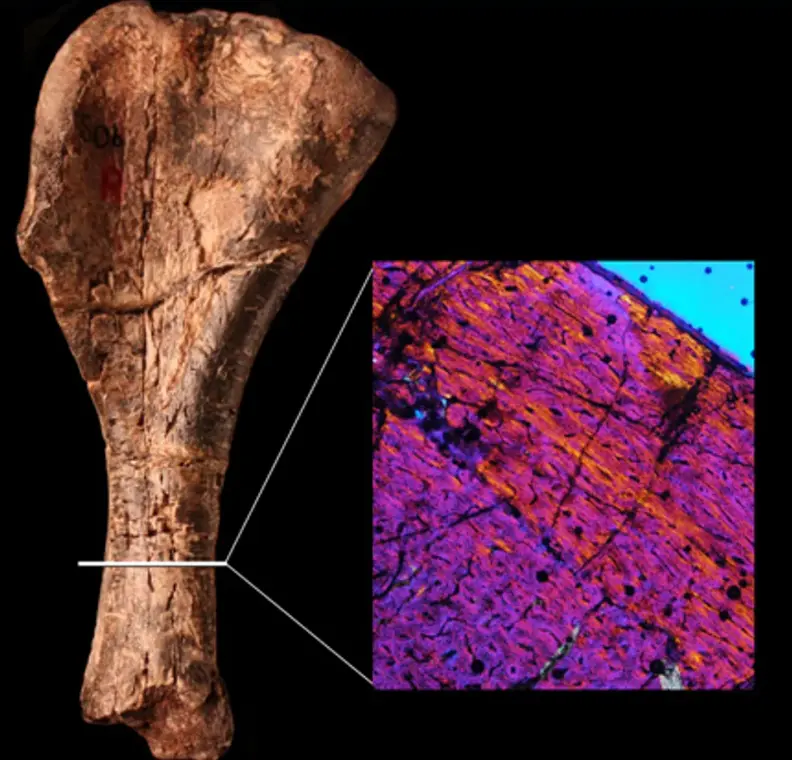
Oldest Dinosaur Fossil discussions often return to Nyasasaurus parringtoni, a mysterious animal known from fragmentary remains discovered in Tanzania. These fossils may date back as far as 243 million years ago, potentially predating other dinosaur fossils by 10 to 15 million years.
The evidence includes a partial humerus bone with internal structures resembling those seen in early dinosaurs. Microscopic analysis reveals fast-growing bone tissue, a hallmark of dinosaur metabolism.
However, the fossil record for Nyasasaurus is incomplete. With only a few fragments available, scientists cannot definitively confirm whether it was a true dinosaur or a very close relative.
The age of the surrounding rock has also been debated. If the rock layer is slightly younger than originally believed, Nyasasaurus may lose its claim to the title—but not its importance.
As one researcher famously noted, even if Nyasasaurus is not the earliest dinosaur, it may be the closest known ancestor yet discovered.
Subheading: Oldest Dinosaur Fossil vs Dinosaur Ancestors
Understanding the difference between dinosaurs and their ancestors is crucial. Dinosauriforms shared many features with early dinosaurs, including upright posture and similar limb structures.
What sets true dinosaurs apart is a unique combination of skeletal traits rather than a single defining feature. This is why early fossils are so difficult to classify and why debates over classification can last decades.
This distinction also explains why scientists remain cautious when labeling any specimen as the absolute oldest dinosaur fossil.
Could Older Dinosaur Fossils Still Exist?
Many researchers believe the answer is yes.
A 2025 modeling study suggested that the earliest dinosaurs likely evolved in western, low-latitude Gondwana, a region that once included parts of South America, Africa, and possibly Antarctica.
These areas were hotter and drier than previously thought, resembling deserts and savannahs rather than lush forests. Today, those same regions are some of the hardest places on Earth to conduct fossil research.
Dense rainforests like the Amazon and vast deserts like the Sahara pose enormous logistical challenges. Thick vegetation, extreme heat, political instability, and limited infrastructure all make large-scale excavations difficult.
As a result, the earliest dinosaur fossils may still be buried beneath environments that humans are only beginning to explore with modern technology.
Technology May Rewrite Dinosaur History
Advances in satellite imaging, ground-penetrating radar, and geochemical dating are transforming paleontology. These tools allow scientists to identify promising fossil sites without extensive digging and to date rock layers with greater precision.
As exploration expands into previously inaccessible regions, long-standing gaps in the fossil record may finally be filled.
If older dinosaur fossils are discovered, they could fundamentally change our understanding of dinosaur origins, evolution, and how these animals came to dominate terrestrial ecosystems for over 160 million years.
Why the Oldest Dinosaur Fossil Still Matters
The search for the oldest dinosaur fossil is not just about bragging rights or record-setting. It helps scientists understand how life responds to mass extinctions, climate shifts, and environmental stress.
Dinosaurs emerged after the Permian extinction, the most devastating extinction event in Earth’s history. Understanding how early dinosaurs survived and adapted offers insight into resilience, evolution, and the future of life on a changing planet.
Each new fossil adds another piece to that story—and reminds us how much remains hidden beneath our feet.