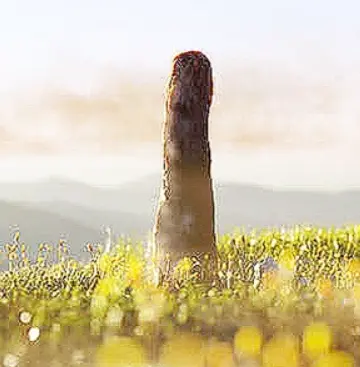
For more than a century and a half, researchers have struggled to explain the identity of a strange organism known as Prototaxites. First described in the mid-19th century, these fossils resemble massive tree trunks, some estimated to have reached heights of nearly 26 feet. They appeared during the late Silurian and early Devonian periods, at a time when Earth’s landscapes were just beginning to host complex life on land.
When the fossil was initially discovered in 1859, Canadian geologist John William Dawson assumed it represented decaying conifer trees. That interpretation did not last. As paleontology advanced, so did doubts. The structure had no leaves, no branches, and none of the internal features typical of plants. Over time, the fossil became one of the most hotly debated enigmas in Earth science.
A long-running debate: was the Prototaxites fossil a giant fungus?
For decades, the leading explanation was that the Prototaxites fossil represented a colossal terrestrial fungus. This idea gained momentum in the early 2000s, when microscopic studies revealed networks of tube-like structures resembling fungal hyphae. Some researchers even suggested that small internal features were primitive fruiting bodies, linking Prototaxites to modern fungal groups.
Yet the fungal hypothesis always came with caveats. The supposed reproductive structures were never convincingly connected to the rest of the organism. Without that link, the argument relied more on resemblance than proof. Still, in the absence of better explanations, the fungus theory persisted.
That changed when a research team from the University of Edinburgh decided to revisit one of the best-preserved specimens ever found.
Inside the Prototaxites fossil from Scotland’s Rhynie chert
The scientists focused on Prototaxites taiti, preserved within the famous Rhynie chert. This site is renowned for its extraordinary fossil detail, capturing early land ecosystems down to the cellular level.
Using advanced imaging techniques, the team examined a cylindrical fossil fragment only a few centimeters wide. Despite its small size, the structure hinted at an organism that once dominated its environment, possibly standing taller than any other life form of its time.
Microscopic analysis revealed three distinct types of internal tubes:
- Thin, branching tubes with internal cross-walls
- Wider, smooth-walled tubes lacking septa
- Exceptionally thick tubes with ring-like internal reinforcements
This third tube type proved crucial. No known fungal group, living or extinct, shows this exact feature. The tubes formed a dense, chaotic network rather than the orderly branching systems seen in fungi today.
Medullary spots: a feature unknown in modern organisms
Even more puzzling were dark, circular regions scattered throughout the fossil, known as medullary spots. Using 3D laser microscopy, researchers discovered that these zones contained all tube types plus even finer filaments, some measuring just one micron across.
In modern fungi, growth follows a hierarchy: certain hyphae generate others in predictable patterns. The Prototaxites fossil showed no such organization. Tubes branched in every direction, creating a tangled mesh with no clear developmental logic.
According to the research team, there are no known structures in living fungi that resemble these medullary spots. This alone cast serious doubt on the long-standing fungal interpretation.
Chemical evidence rules out fungi and plants
To go further, the scientists analyzed the fossil’s molecular composition using infrared spectroscopy. They compared the Prototaxites fossil with plants, fungi, bacteria, and animals preserved in the same deposit, ensuring fair comparison under identical fossilization conditions.
The results were striking:
- No chitin or chitosan, key components of fungal cell walls
- No perylene, a chemical marker often associated with ascomycete fungi
- Presence of aromatic and phenolic compounds resembling lignin, but chemically distinct from plant lignin
In short, the fossil did not chemically match fungi, plants, or any other known group.
Machine learning confirms the Prototaxites fossil stands alone
To remove any lingering doubt, the team turned to machine learning. By training algorithms to recognize molecular signatures of known organisms, they tested where Prototaxites fit.
It didn’t.
With over 90 percent accuracy, the models classified the Prototaxites fossil as separate from fungi, plants, animals, and bacteria. The conclusion was unavoidable: this organism belonged to a completely extinct lineage of complex life.
The researchers summarized their findings by stating that Prototaxites taiti represents “a previously undescribed group of eukaryotes,” meaning it had complex cells but no living relatives.
Not a plant, fungus, animal, or alga
Every alternative hypothesis was systematically rejected. The Prototaxites fossil lacked photosynthetic structures, ruling out algae. It showed no vascular tissue, eliminating plants. It could not be an animal, as animals do not build rigid tube networks with cell walls. Even lichen and fungus-like organisms failed to match the evidence.
The verdict was unanimous across all tests: Prototaxites does not fit anywhere on today’s tree of life.
Prototaxites fossil as evolution’s lost experiment
Scientists now believe Prototaxites formed vast underground networks that supported towering vertical structures. It likely fed by absorbing nutrients from decaying organic matter, occupying a role similar to modern decomposers, but through a completely different biological design.
Without descendants or close relatives, Prototaxites appears to be a dead-end experiment in evolution. Its disappearance left no trace beyond stone impressions locked in ancient rock.
The findings, published in Science Advances, remind us that early life on Earth was far more experimental than previously imagined. Entire branches of complex organisms rose, thrived, and vanished long before familiar plants and animals took over.